Learning Outcomes
i. Master the concept of centripetal force, the force responsible for keeping objects moving in circular paths.
ii. Derive the equation for centripetal force, F = mrω², which relates the magnitude of the centripetal force to the object's mass (m), its angular velocity (ω), and the radius of curvature (r) of the path.
iii. Understand the alternative expression for centripetal force, F = mv²/r, where v is the linear velocity of the object.
iv. Recognize that centripetal force is always directed towards the center of the circular path, providing the necessary acceleration for the object to maintain its curved motion.
v. Effectively apply the concept of centripetal force to solve problems involving circular motion, such as determining the centripetal force required to keep a car on a circular track or a satellite in orbit around the Earth.
Introduction
In our previous lessons, we delved into the concepts of centripetal acceleration and its role in circular motion. In this lesson, we take a crucial step forward by introducing the force that provides this acceleration: centripetal force. We will explore the relationship between centripetal force, mass, angular velocity, and radius of curvature, and apply our understanding to solve problems involving circular motion.
i. Deriving the Equation for Centripetal Force
Recall that centripetal acceleration (a) is the acceleration experienced by an object moving in a circular path. We derived the equation for centripetal acceleration as a = rω².
Based on Newton's second law of motion, force (F) is equal to mass (m) multiplied by acceleration (a). In the case of circular motion, where the acceleration is centripetal acceleration, we can express centripetal force as:
F = ma
Substituting the equation for centripetal acceleration (a = rω²), we obtain the equation for centripetal force:
F = mrω²
ii. Alternative Expression for Centripetal Force
Recalling the relationship between linear velocity (v) and angular velocity (ω), v = rω, we can substitute this expression into the equation for centripetal force to obtain an alternative form:
F = mv²/r
iii. Direction of Centripetal Force
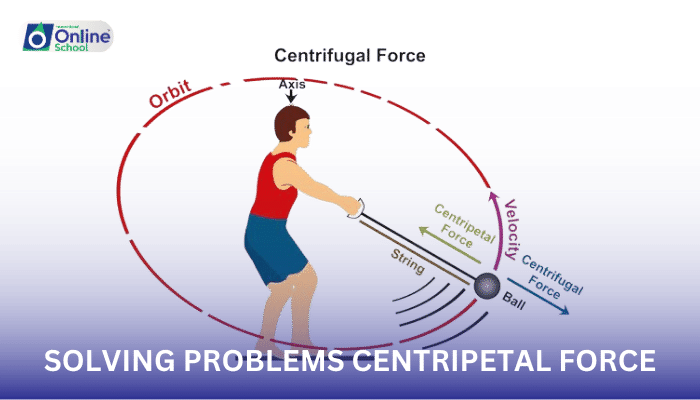
Centripetal force is always directed towards the center of the circular path. This inward force provides the necessary acceleration for the object to continuously change its direction and maintain its curved motion.
iv. Applications of Centripetal Force
Centripetal force has widespread applications in various fields:
Engineering: Engineers utilize centripetal force in designing and analyzing rotating machinery, such as centrifuges, turbines, and amusement park rides.
Physics: Centripetal force plays a crucial role in understanding the motion of planets and satellites, the behavior of objects in curved paths, and the dynamics of circular motion.
Everyday Examples: We encounter centripetal force in everyday life, from the motion of a car turning on a circular track to the spinning of a ball on a string or the swirling of water in a drain.
Centripetal force provides a fundamental understanding of the force that keeps objects moving in circular paths. By mastering the equation for centripetal force and recognizing its direction and applications, we gain a deeper appreciation of the intricacies of circular motion and its significance in various physical phenomena.
